Project Brief
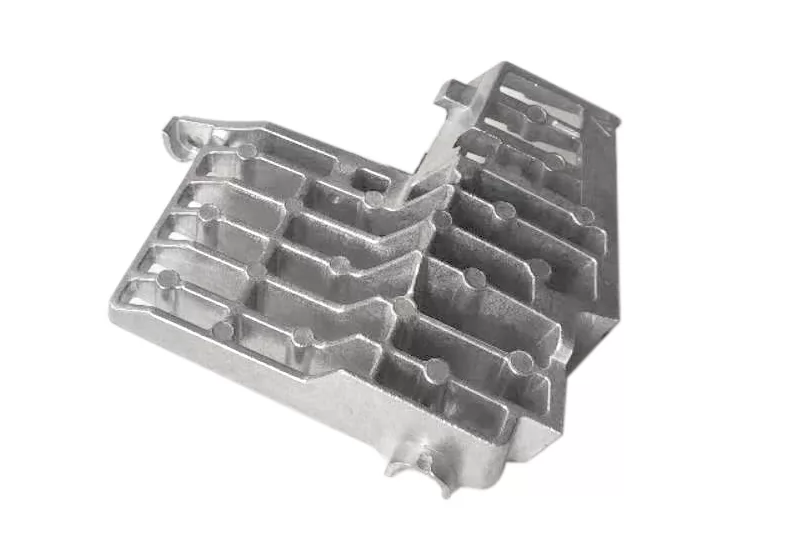
This is a custom automotive circuit heat sink casting, which performs multiple functions including heat dissipation, component protection, mechanical support, and installation.
1. Product Standards & Requirements: Material: EN AC46000; full-size tolerance grade: ISO 2768-mk; Minimum dimensional tolerance is ±0.05mm; surface free of defects (surface roughness Ra6.3µm); internal free of defects. Before official mass production, PPAP approval must be completed and passed.
2. Product Challenges: Complex structure with multiple stepped levels, posing high demands on mold design; deburring is complicated; machining holes are located in different orientations, making the structure extremely difficult to process.
Risk Keywords: complex structure, step processing, fracture, cold shut, incomplete filling.
Overall, this project presents a certain level of difficulty, particularly testing our mold design capability and quality control capability.
Development Process
1. Following the APQP (Advanced Product Quality Planning) process, we established a project development team consisting of mold designers, casting engineers, machining engineers, measurement engineers, quality engineers, and sales staff, entering a full product development process with quality at the core.
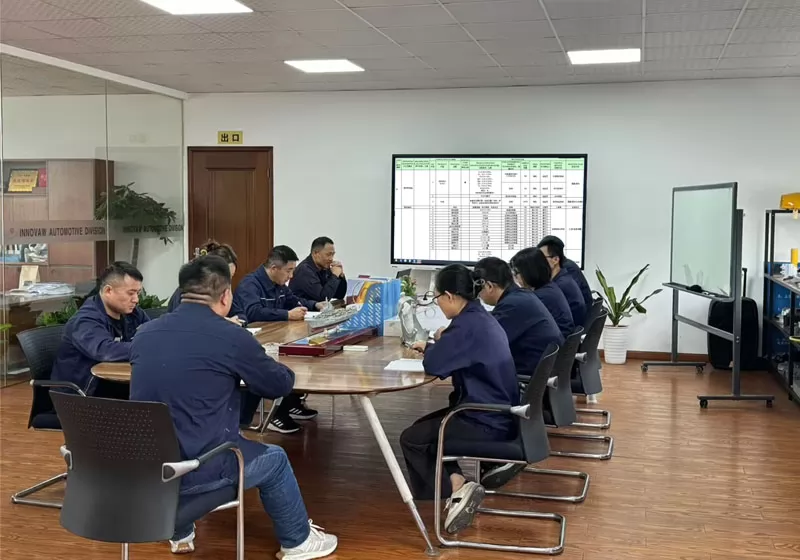
2. Through DFM analysis, certain structural details of the product were optimized to improve manufacturability, and jointly recognized technical specifications and quality standards were established with the customer.
3. Based on the material properties, and integrating the core design elements of this product, the final process route was determined as high-pressure die casting + CNC precision machining, from the perspectives of technical feasibility, quality stability, and cost control.
4. Technical engineers conducted mold scheme reviews, mold design and simulation, mold flow analysis, predicting and optimizing various challenges and process parameters, and provided die-casting simulation analysis reports to the customer.
5. During subsequent production processes, the solutions were gradually validated, and problems were discovered and resolved. Key cases include:
• During trial molding, incomplete die casting was found, which was solved by modifying the mold gate and adjusting die-casting parameters.
• Deburring after die casting was difficult; both robotic and manual deburring solutions faced challenges, so a dedicated trimming die was developed to solve the issue.
• Due to the product structure, machining was difficult. The development team designed a dedicated machine integration solution, adopting an assembly-line process to overcome the machining challenge.
Throughout the development process, FMEA, SPC, MSA, process control plans, and other standard documents were established. Finally, PPAP documentation was completed and approved by the customer.
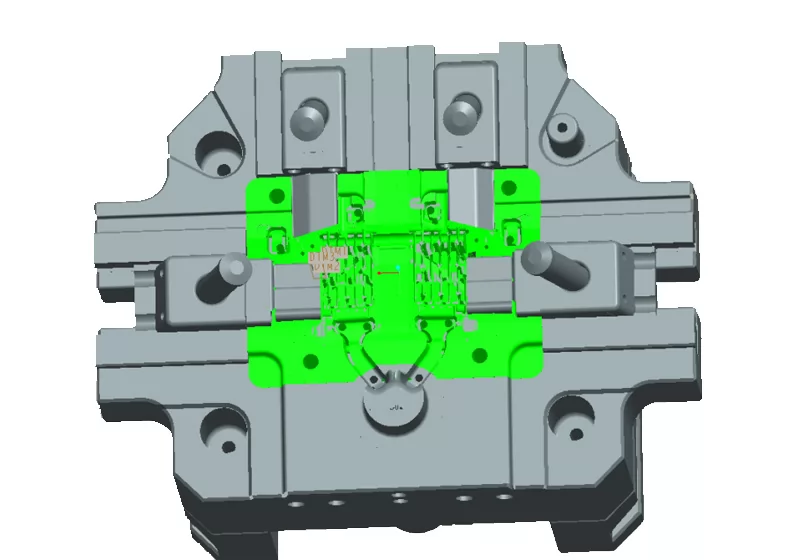
This automotive circuit heat sink aluminum casting not only demonstrates excellent performance and precision, but also features good thermal conductivity, corrosion resistance, lightweight properties, strong protective capabilities, and ease of installation and maintenance. The finished product fully met the customer’s design objectives, providing a higher-performance and more reliable solution for this type of automotive component design.
Production Process
Mould making→Melting→High Pressure Die Casting→Cutting the sprue and riser→Deburring→Drilling→Reaming of pin holes→Vibratory Finishing→Packaging & inspection
FAQs
Q1. What functions does this automotive circuit heat sink serve beyond heat dissipation?
In addition to dissipating heat from the automotive control circuit, this casting simultaneously provides component protection, mechanical support, and mounting functions. The multi-stepped structure integrates all these roles into a single aluminum part, which is why the geometry is significantly more complex than a standard fin-array heat sink—and why both mold design and CNC machining present particular challenges on this product.
Q2. What makes the multi-stepped structure of this heat sink difficult to die cast?
The multiple stepped levels create complex metal flow paths inside the mold, making it prone to incomplete filling and cold shuts—particularly at transitions between steps where the cross-section changes abruptly. During trial molding, incomplete die casting was observed and resolved by modifying the gate design and adjusting injection parameters. The stepped geometry also creates challenging parting line and ejection conditions, placing high demands on mold layout and slider configuration.
Q3. Why does this part require CNC machining after die casting, and what makes it difficult?
The machined holes on this heat sink are located in multiple orientations, meaning the part cannot be fixtured and machined from a single direction. This requires repositioning between operations and precise datum control to maintain a minimum tolerance of ±0.05mm across all hole positions. To manage this complexity efficiently, a dedicated assembly-line machining integration solution was developed, enabling sequential multi-orientation operations within a controlled, repeatable process rather than relying on manual repositioning.
Q4. Why was a dedicated trimming die developed for deburring this casting?
The complex stepped structure and multiple hole orientations make standard deburring approaches impractical. Both robotic and manual deburring were evaluated but found to be either inefficient or unable to reliably reach all flash locations on this geometry. A dedicated trimming die was therefore developed to remove flash from all peripheral and hole features in a controlled single-step operation, ensuring consistent deburring quality without relying on operator skill or robot path programming for a difficult 3D profile.
Q5. What is the minimum dimensional tolerance achieved on this part, and which features are most critical?
The overall dimensional tolerance grade is ISO 2768-mk, with a minimum local tolerance of ±0.05mm. The most critical features are the machined holes in different orientations, which serve as mounting and interfacing points for the automotive circuit components assembled onto this heat sink. Achieving ±0.05mm across multi-directional hole patterns on a 110 × 90 × 30mm casting requires tight process control at both the die casting stage—to minimize blank distortion—and the CNC machining stage, where fixture design and datum selection are key.
Share your thoughts
Showing
6
of
0
reviews