Billet vs Cast Explained: Strength, Cost, and Applications — Everything You Need to Know
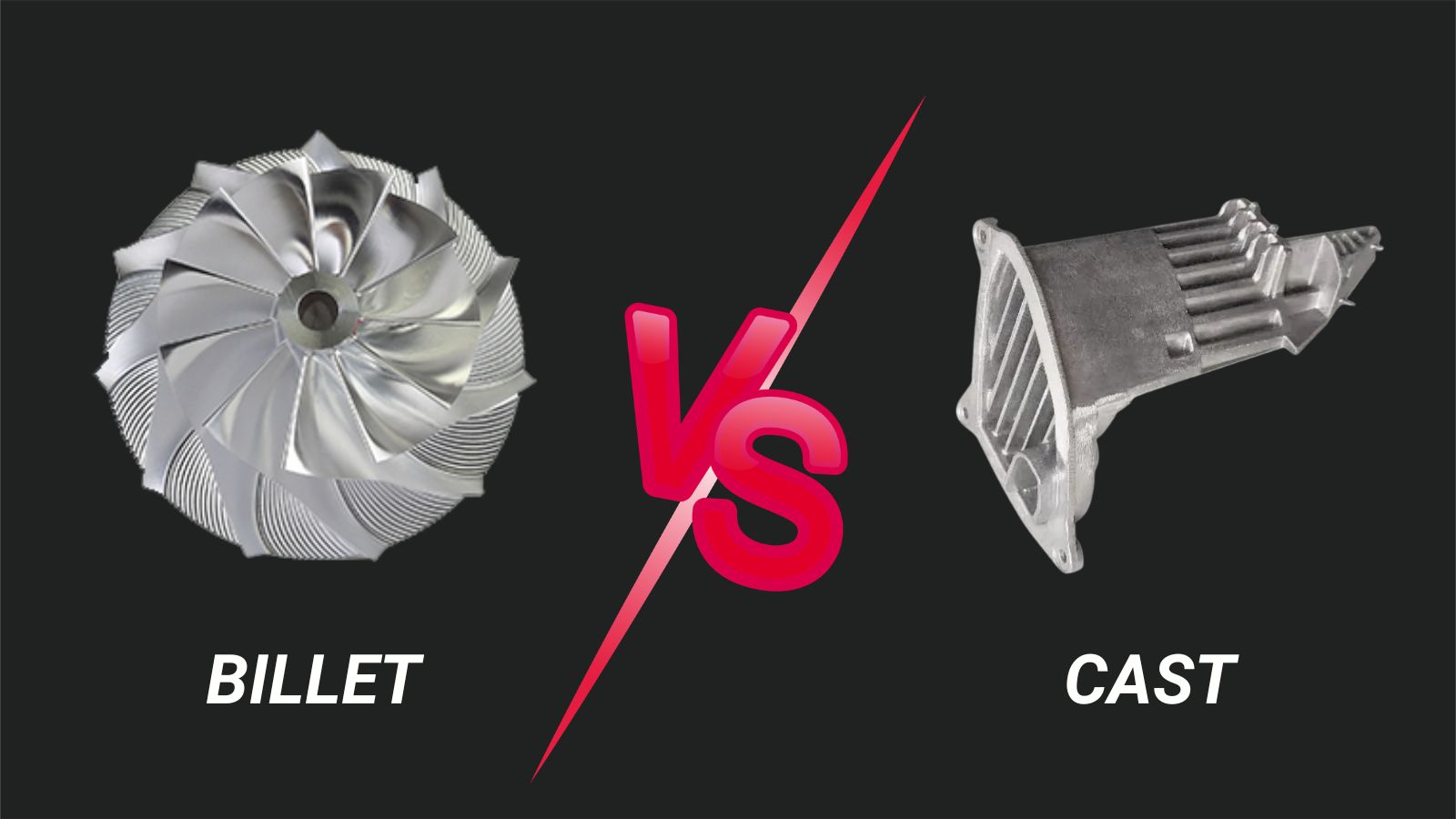
_1773805429_WNo_1600d900.webp)
The debate over billet vs cast is one of the most consequential decisions in metal parts manufacturing — yet it's frequently made on instinct rather than data. With global aluminum casting markets projected to exceed $100 billion by 2027 and CNC machining demand growing steadily alongside it, choosing the wrong process can mean wasted tooling budgets, missed performance targets, or parts that fail before their time.
This guide cuts through the noise with industry-backed data and real-world engineering insight. Here's what you'll find inside:
- A clear breakdown of how billet and cast parts differ in strength, cost, and geometric capability
- Mechanical property data for the most common alloys, so you can compare numbers — not just claims
- A volume-based cost framework to identify the break-even point for your production run
- Industry-specific application guidance for automotive, aerospace, motorsport, and consumer products
Whether you're a mechanical engineer specifying safety-critical components, a procurement manager balancing unit cost against quality, or a product designer choosing a manufacturing process for the first time, the right choice between billet and cast will define your part's performance, cost, and reliability from day one — read on to make that choice with confidence.
Billet vs Cast: Quick Answer
- Choose Billet: Best for low-volume production, high precision, tight tolerances, and superior strength.
- Choose Cast: Ideal for high-volume production, complex geometries, and lower per-unit cost.
- Break-even point: Casting becomes more cost-effective at ~500–5,000 units.
Bottom line: If your part requires complex internal geometry or high volume, go with casting. If precision and strength matter most at low volumes, billet is the better choice.
Table of Contents
- Why the Billet vs Cast Debate Matters
- What Is Billet? Definition, Process & Materials
- What Is Casting? Definition, Process & Materials
- Billet vs Cast: Key Differences at a Glance
- Strength & Mechanical Properties: Which Is Stronger?
- Cost Comparison: Billet vs Cast
- Design Flexibility, Complexity & Material Efficiency
- Billet vs Cast in Specific Materials
- Industry Applications: Where Each Method Excels
- Billet vs Cast vs Forged: What's the Real Difference?
- How to Choose: Billet or Cast?
- Frequently Asked Questions
- Conclusion
Why the Billet vs Cast Debate Matters
Walk into any machine shop, motorsport garage, or aerospace engineering department, and you'll quickly hear the terms "billet" and "cast" thrown around with strong opinions attached to each. The debate has real stakes: the wrong choice can mean parts that fail under load, budgets blown on over-engineered components, or production timelines derailed by mismatched manufacturing processes.
At its core, billet and casting represent two fundamentally different philosophies for turning raw metal into functional parts. One starts with a solid block and subtracts material until the desired shape remains. The other begins with liquid metal and adds it into a mold to form the shape directly. Each approach carries its own set of trade-offs in strength, cost, design freedom, and suitability for different industries.
The core question isn't which method is "better" in absolute terms — it's which method is better for your specific application. A racing engine piston has entirely different requirements than an automotive gearbox housing or an aircraft bracket.
Understanding these trade-offs is essential for engineers, procurement managers, product designers, and anyone involved in specifying manufactured parts. This guide provides a complete, application-focused framework to navigate the decision.
Who Should Read This Guide
- Mechanical Engineers — Specifying parts where strength, tolerance, and failure modes are critical considerations.
- Procurement & Manufacturing Teams — Balancing cost, lead time, and supplier capabilities across different production volumes.
- Performance Enthusiasts — Evaluating aftermarket upgrades in automotive, motorsport, and off-road applications.
- Aerospace & Defense Professionals — Where material traceability, consistency, and structural integrity are non-negotiable.
The Fundamental Trade-Off in One Sentence
Billet delivers superior precision and strength at a higher cost and with greater material waste; casting enables complex geometries and high-volume production at a lower per-unit cost, with some trade-offs in internal material consistency.
With that framework in mind, let's start from the ground up — beginning with exactly what each method involves.
What Is Billet? Definition, Process & Materials
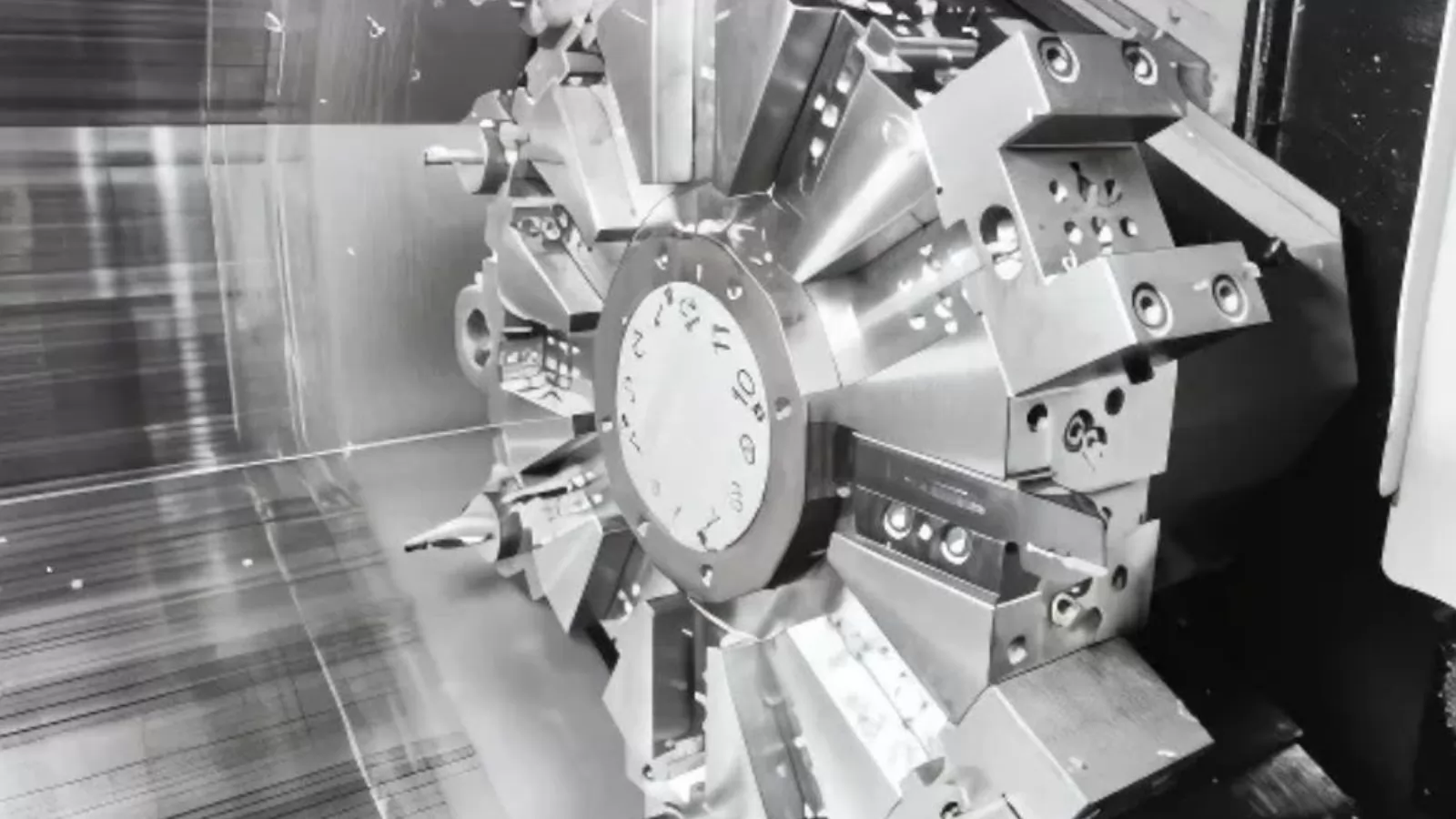
A billet is a solid, pre-formed block or bar of metal — typically with a uniform cross-section — that serves as the raw starting material for machining. The term originally referred to a semi-finished product in metallurgy (a step between raw ingot and finished bar stock), but in modern manufacturing, "billet" almost always refers to a part that has been precision-machined from such a solid block.
Billet manufacturing is a subtractive process: material is removed from the starting block through cutting, milling, drilling, turning, or other machining operations until the finished component shape is achieved. Because the entire piece originates from a single, homogeneous block of metal, the resulting part maintains a continuous, uninterrupted grain structure throughout.
The Billet Manufacturing Process
-
1
Raw Material Selection A solid block or bar of the appropriate alloy is selected based on machinability, mechanical requirements, and finishing needs. Common choices include 6061-T6 and 7075-T6 aluminum, or 4130/4340 steel.
-
2
CNC Programming & Setup A CNC (Computer Numerical Control) machine is programmed with the part's exact 3D geometry. Multi-axis machining centers can produce highly complex geometries by approaching the workpiece from multiple angles.
-
3
Machining & Material Removal Cutting tools progressively remove material through roughing passes (fast material removal) and finishing passes (precision surface quality). Tolerances of ±0.001 inch or tighter are routinely achievable.
-
4
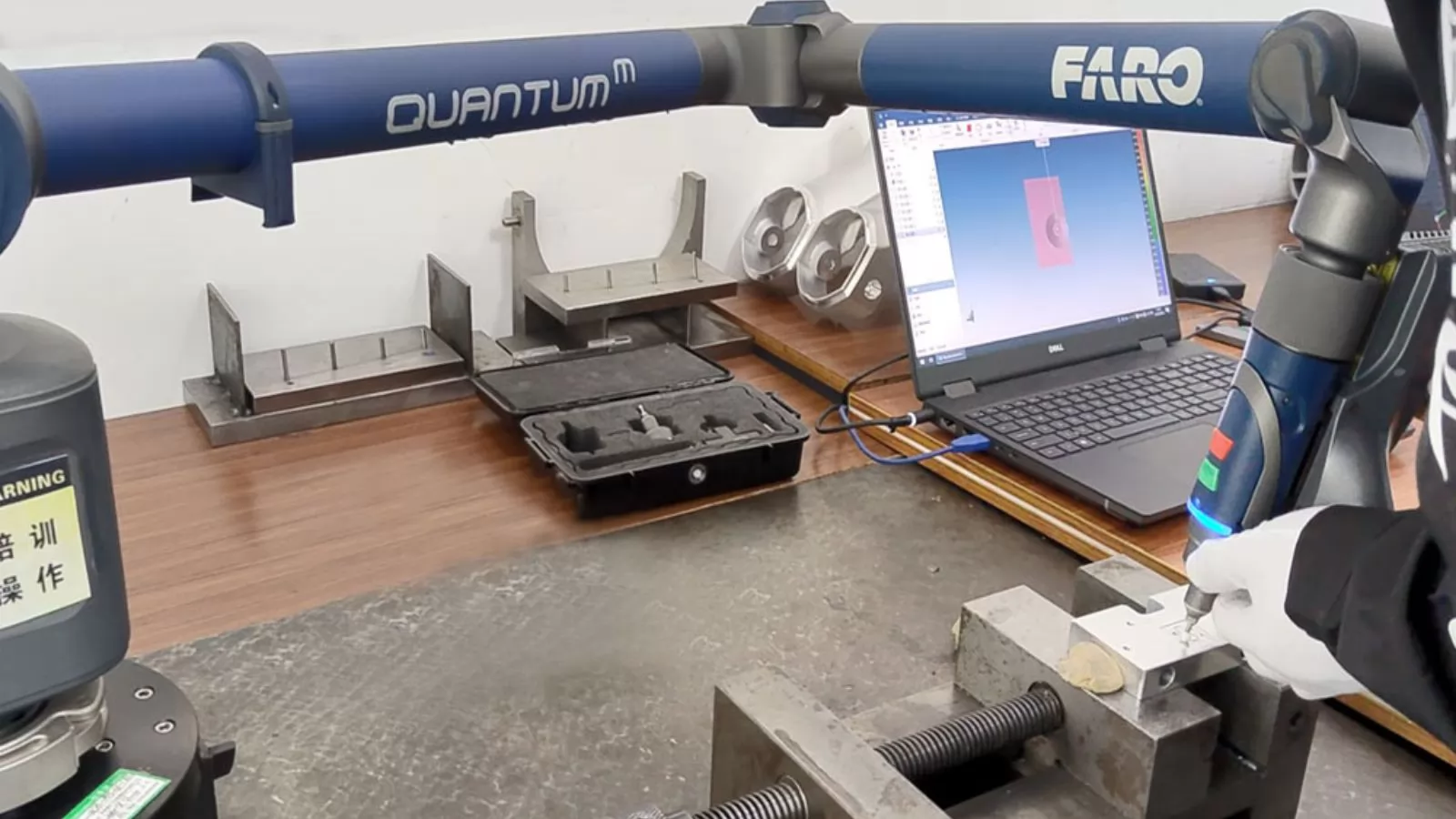
Inspection & Quality Control Finished parts are measured using coordinate measuring machines (CMMs) or optical inspection tools to verify dimensional accuracy against engineering drawings.
-
5
Surface Finishing (Optional) Billet parts may undergo anodizing, hard coating, or polishing. The smooth, consistent machined surface accepts these finishes exceptionally well.
Common Billet Materials
Aluminum Alloys: 6061-T6 (general purpose, excellent machinability), 7075-T6 (high strength, aerospace grade), 2024-T4 (fatigue resistance).
Steel Alloys: 4130 Chromoly (structural, motorsport), 4340 (high-strength applications), 303/316 Stainless (corrosion resistance).
Other Metals: Titanium Ti-6Al-4V, copper alloys, brass, Inconel (high-temperature environments).
Billet vs Forging: Clearing Up a Common Confusion
The terms "billet" and "forged" are sometimes used interchangeably in casual conversation — particularly in the automotive aftermarket — but they are not the same thing. A forged part is shaped by compressing hot or cold metal under high pressure, which refines the grain structure and enhances strength. A billet part is machined from a solid block without any compressive deformation. Forgings can subsequently be machined from billet stock, but machining from billet does not constitute forging. The general strength hierarchy runs: Forged > Billet > Cast — though this depends heavily on alloy selection and part geometry.
What Is Casting? Definition, Process & Materials
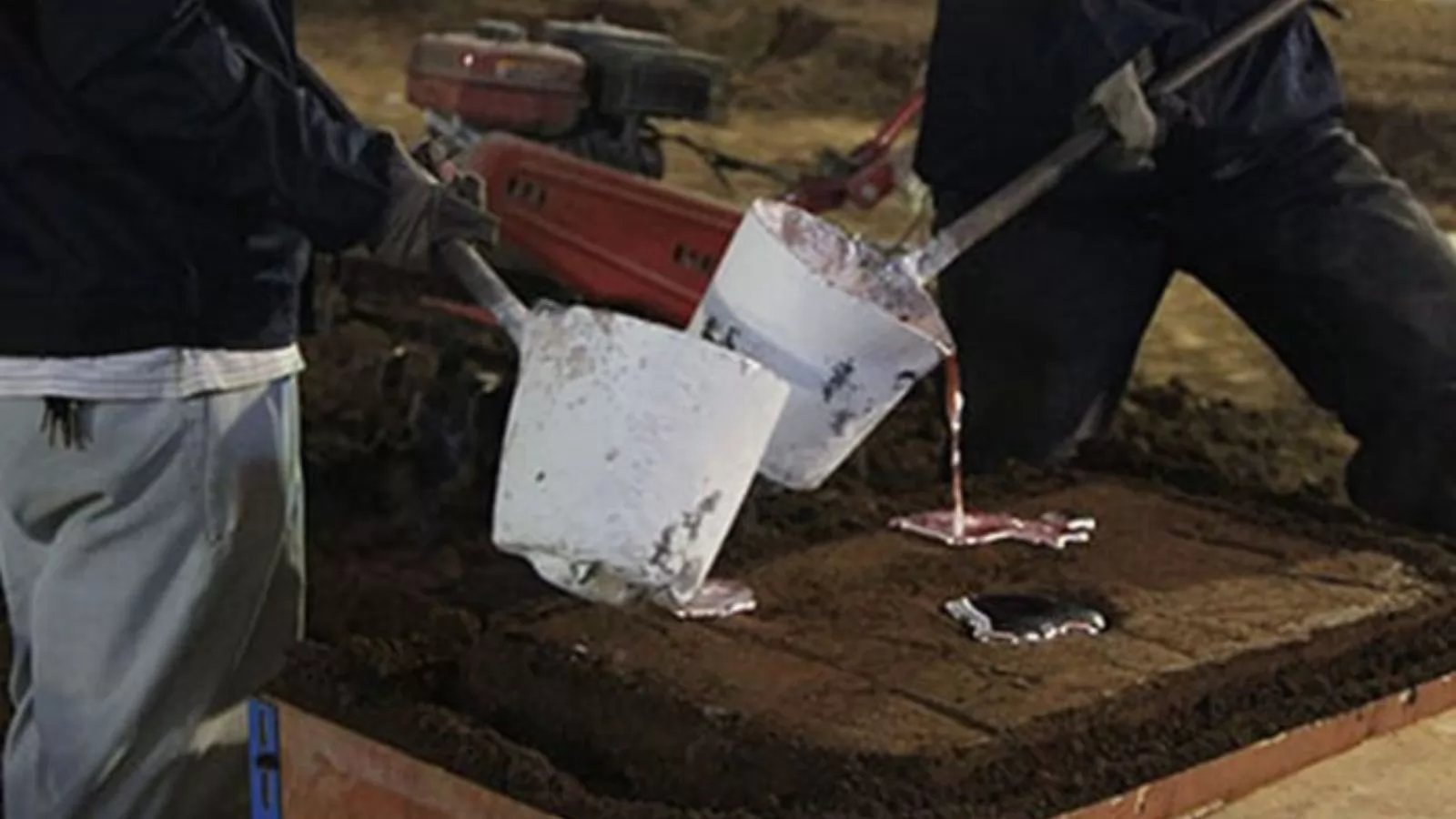
Casting is an additive shaping process in which molten metal is poured or injected into a mold cavity, allowed to solidify, and then removed to produce a part that closely conforms to the mold's interior shape. Unlike machining, which removes material from a solid block, casting builds the part's shape through controlled solidification of liquid metal.
This fundamental difference gives casting its most powerful advantage: the ability to produce highly complex, near-net-shape geometries — including internal channels, undercuts, and thin-walled structures — that would be extremely difficult or cost-prohibitive to machine from solid billet stock.
Major Casting Processes
Casting is not a single, monolithic process — it encompasses a family of techniques, each suited to different part sizes, tolerances, production volumes, and material requirements.
| Process | How It Works | Best For | Typical Tolerance |
|---|---|---|---|
| Sand Casting | Molten metal poured into a sand mold formed around a pattern | Large parts, low volumes, iron & steel | ±0.015–0.030 in |
| Die Casting | Molten metal injected under high pressure into a steel die | High-volume aluminum/zinc parts | ±0.002–0.005 in |
| Investment Casting | Wax pattern coated in ceramic shell; wax melted out, metal poured in | Complex precision parts, aerospace | ±0.005–0.010 in |
| Gravity Die Casting | Molten metal poured by gravity into a permanent metal mold | Medium volumes, aluminum & copper alloys | ±0.010–0.020 in |
| Lost Foam Casting | Foam pattern vaporized by molten metal during the pour | Complex geometry, engine components | ±0.010–0.020 in |
The Casting Process: Step by Step
-
1
Mold / Die Design & Fabrication A mold (sand, ceramic, or steel die) is designed to define the part geometry. For permanent molds and dies, this upfront tooling investment can be substantial but is amortized across high production volumes.
-
2
Metal Melting & Preparation The alloy is melted in a furnace to the required temperature. Degassing and flux treatments may be applied to reduce dissolved hydrogen and minimize porosity in the finished casting.
-
3
Pouring / Injection Molten metal fills the mold cavity by gravity, pressure (die casting), or vacuum-assisted methods. Flow pattern and cooling rate are carefully engineered to avoid defects such as shrinkage voids or cold shuts.
-
4
Solidification & Cooling As the metal cools, it transitions from liquid to solid. Controlled cooling rates are essential — too fast causes thermal stresses and cracking; too slow can coarsen the grain structure and reduce mechanical properties.
-
5
Ejection, Shakeout & Cleanup The solidified part is removed from the mold. Gates, risers, and flash are trimmed away, and the part surface is cleaned by shot blasting or grinding.
-
6
Secondary Machining & Heat Treatment Many cast parts require post-casting machining of critical surfaces (bores, mounting faces, threaded holes) to meet final dimensional tolerances. Heat treatment such as T5 or T6 temper may be applied to aluminum castings to improve mechanical properties.
Common Casting Materials
Aluminum Casting Alloys: A380 (die casting workhorse — excellent fluidity), A356 (sand & permanent mold — heat-treatable), A319 (engine blocks, cylinder heads).
Ferrous Alloys: Gray Cast Iron (engine blocks, brake rotors), Ductile Iron (higher toughness), Carbon Steel.
Other: Zinc Zamak alloys (die casting), Magnesium AZ91D, Copper and Bronze alloys.
A Key Characteristic of Cast Parts: Internal Structure
When metal solidifies in a mold, the cooling process creates a microstructure that differs from wrought (billet) material. Grain boundaries in cast metal tend to be coarser and less uniformly oriented, and the solidification process can introduce internal porosity — microscopic voids caused by dissolved gases escaping as the metal cools, or by shrinkage as the metal contracts.
Porosity is not a defect to be avoided at all costs — it is an inherent characteristic of the casting process that engineers account for in design. Modern casting techniques and post-process treatments such as hot isostatic pressing (HIP) have dramatically reduced its impact in critical applications. Understanding its presence simply means designing cast components with appropriate safety factors and selecting the right casting method for the application's structural demands.
With a solid grounding in both processes, we can now move into the head-to-head comparison: how do billet and cast parts stack up across the dimensions that matter most?
Billet vs Cast: Key Differences at a Glance
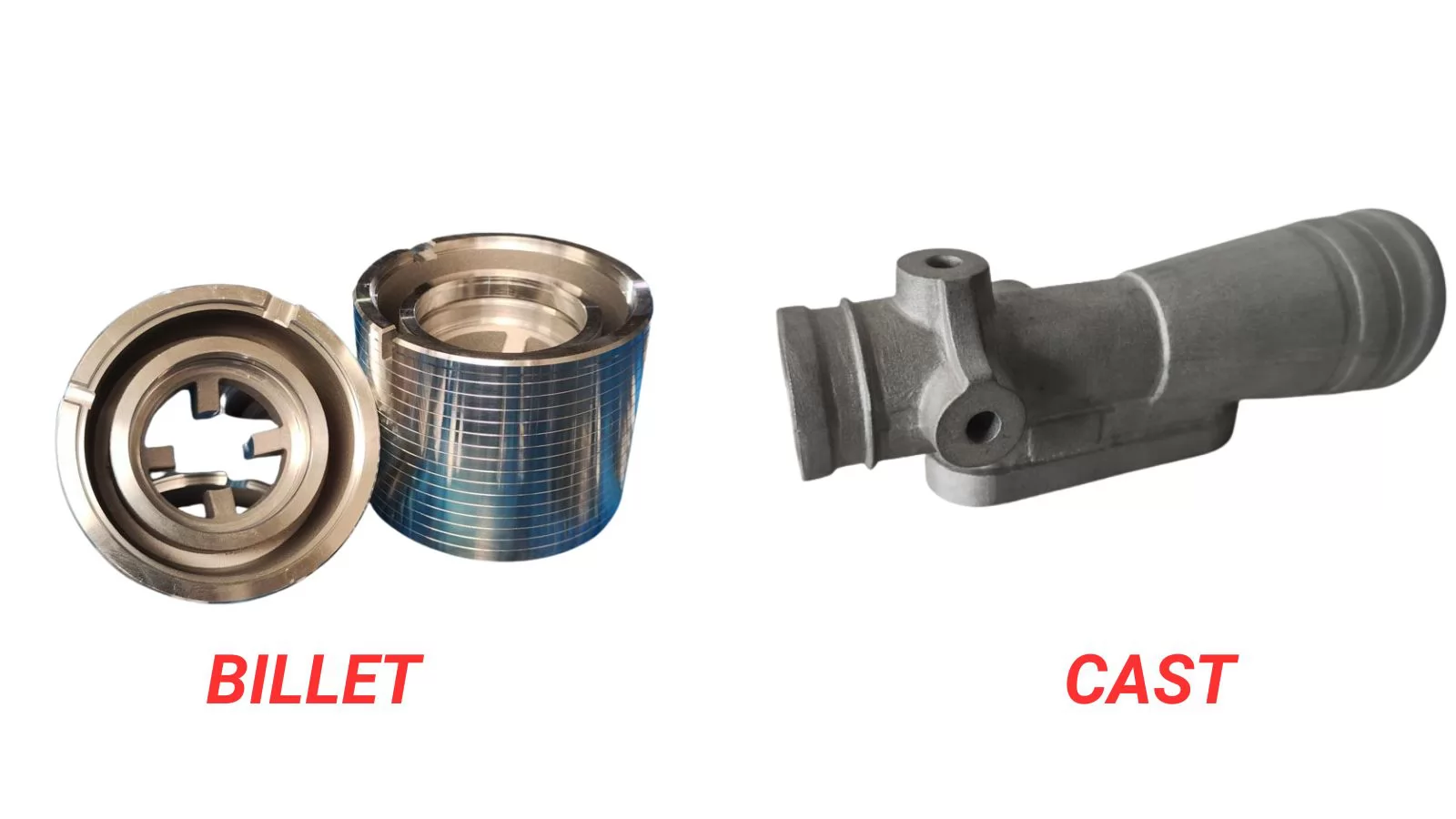
The table below provides a side-by-side snapshot of how billet and cast manufacturing compare across the factors that matter most.
| Factor | Billet | Cast |
|---|---|---|
| Manufacturing Method | Subtractive — machined from solid block | Additive — molten metal poured into mold |
| Grain Structure | Continuous, uniform, uninterrupted | Coarser, directionally variable |
| Dimensional Tolerance | ±0.001 in or tighter | ±0.002–0.030 in (varies by process) |
| Yield Strength (Al) | ~40,000 PSI (6061-T6) | ~23,000 PSI (A380) |
| Design Complexity | Limited by tool access | Excellent — complex internal geometry possible |
| Material Utilization | Low — significant swarf/waste | High — near-net-shape, minimal waste |
| Tooling Cost | Low — no hard tooling required | High — mold or die investment upfront |
| Per-Unit Cost (High Volume) | High (machining time scales linearly) | Low (tooling cost spread across units) |
| Lead Time | Short — no tooling lead time | Longer — mold/die fabrication required |
| Porosity Risk | Minimal | Present — managed by process controls |
| Typical Applications | Aerospace, motorsport, precision instruments | Automotive, consumer goods, industrial housings |
Strength & Mechanical Properties: Which Is Stronger?
Strength is the most debated dimension of the billet vs cast comparison. The answer is more nuanced than "billet is always stronger" — it depends heavily on which alloys are being compared and what type of load the part must withstand.
Yield Strength at a Glance
40,000
PSI Yield Strength
Billet 6061-T6
Billet 6061-T6
73,000
PSI Yield Strength
Billet 7075-T6
Billet 7075-T6
23,000
PSI Yield Strength
Cast A380
Cast A380
30,000
PSI Yield Strength
Cast A356-T6
Cast A356-T6
| Property | Billet 6061-T6 | Billet 7075-T6 | Cast A380 | Cast A356-T6 |
|---|---|---|---|---|
| Tensile Strength | 45,000 PSI | 83,000 PSI | 47,000 PSI | 41,000 PSI |
| Yield Strength | 40,000 PSI | 73,000 PSI | 23,000 PSI | 30,000 PSI |
| Elongation | 12% | 11% | 3.5% | 6% |
| Fatigue Strength | 14,000 PSI | 23,000 PSI | ~10,000 PSI | ~10,000 PSI |
| Porosity Risk | None | None | Moderate | Low–Moderate |
Fatigue, Impact & When Cast Is Enough
Billet Advantages
- Zero porosity — no fatigue crack initiation sites
- Higher elongation — absorbs shock loads better
- Consistent properties throughout the part
Cast Considerations
- Porosity can initiate fatigue cracks under cyclic load
- Lower ductility — more brittle under sudden impact
- HIP treatment can significantly reduce porosity effects
Higher strength doesn't always mean a better part. Engine blocks, gearbox housings, and thousands of other cast components perform reliably for decades because they are engineered to meet their specific load requirements — not to match the properties of aerospace billet. The question is always whether the material is sufficient for the application, not which is categorically superior.
Key Takeaway: Billet generally provides higher strength and fatigue resistance, but casting is sufficient for most non-critical applications.
Cost Comparison: Billet vs Cast
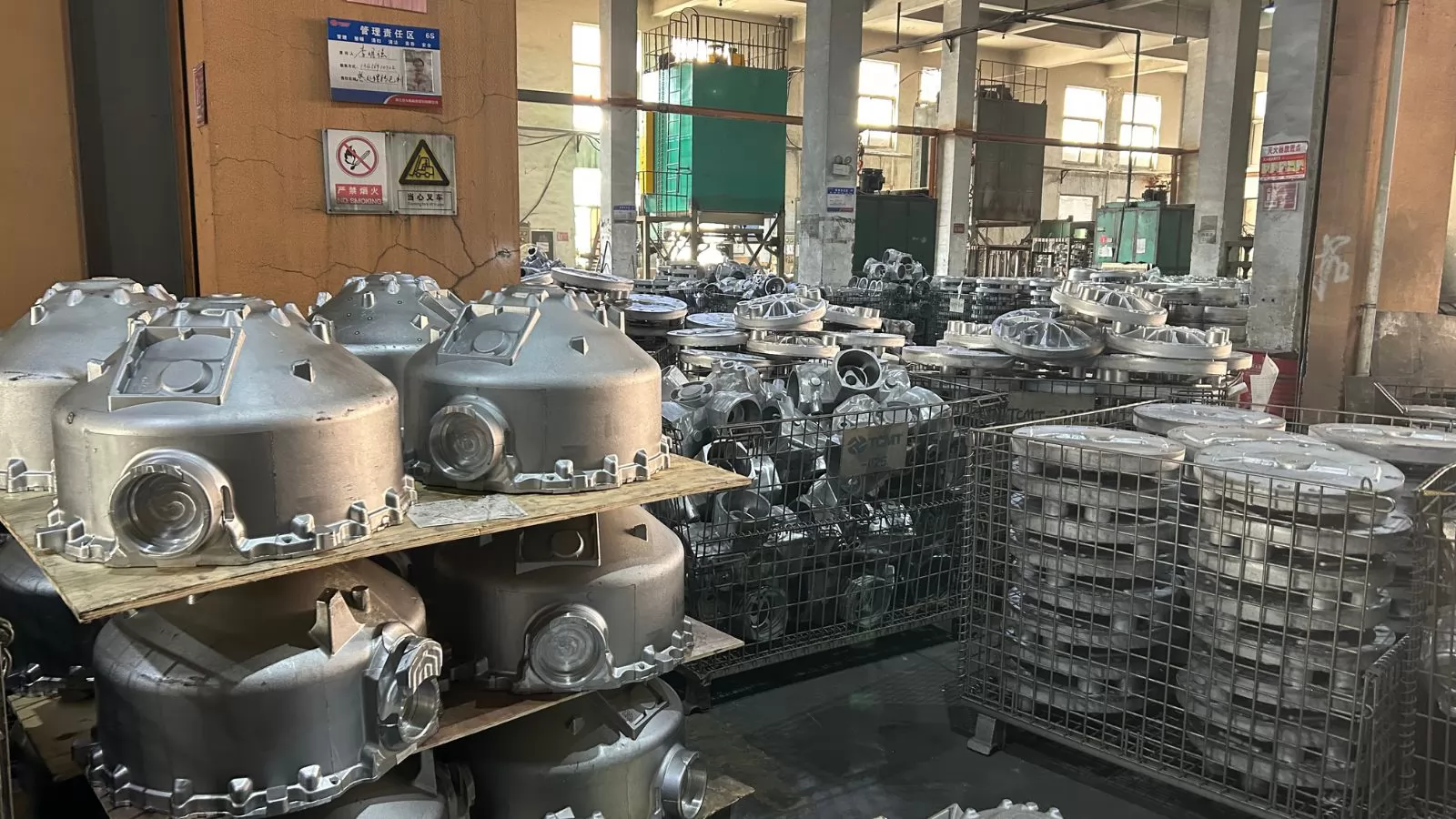
The common assertion that "casting is cheaper" is only partially true. The full picture depends on production volume, part complexity, and secondary operations.
Billet Cost Drivers
- High-grade raw material
- CNC machine time — billed by the hour
- Material waste — up to 60–80% swarf on complex parts
- No tooling cost — fast to start
Casting Cost Drivers
- Upfront mold / die: $10k–$150k+
- Material utilization typically >90%
- Fast cycle times — seconds per part
- Secondary machining often required
The Break-Even Point by Volume
The crossover point where casting becomes cheaper than billet typically falls between 500 and 5,000 units, depending on part complexity and casting method.
| Production Volume | Recommended Method | Rationale |
|---|---|---|
| 1–50 units | Billet machining | No tooling investment; fast turnaround; design flexibility |
| 50–500 units | Billet or sand casting | Depends on complexity; sand casting patterns are low cost |
| 500–5,000 units | Gravity die or investment casting | Tooling investment begins to pay off; better surface quality |
| 5,000+ units | High-pressure die casting | Lowest per-unit cost; fastest cycle times; high consistency |
Don't overlook secondary operations. Cast parts frequently require post-casting machining of bores, sealing faces, and mounting holes — costs that can close the gap considerably. For high-reliability applications, also factor in failure rates, warranty costs, and service life: a billet part that never fails may be cheaper in the long run than a lower-cost casting that needs periodic replacement.
With strength and cost examined, the next section explores design complexity and geometric freedom — a dimension that can make one method simply not viable regardless of cost.
Key Takeaway: Billet is cheaper at low volumes, while casting becomes more cost-effective at scale due to tooling amortization.
Design Flexibility, Complexity & Material Efficiency
Whether the desired geometry is even achievable through a given process is often the deciding factor — one that settles the question before cost or strength are ever considered.
Billet machining excels at tight tolerances, precise bores, flat sealing surfaces, and fine thread forms. Its core limitation is accessibility: internal cavities, enclosed channels, and undercuts are difficult or impossible to produce from solid stock. Because machining always starts from a block larger than the finished part, material utilization is inherently low — buy-to-fly ratios of up to 10:1 are not uncommon in aerospace machining.
Casting handles complex internal geometry — water jackets, manifold passages, hollow structural ribs, variable wall thicknesses — in a single operation, with material placed only where the design requires it. Typical material utilization exceeds 90%, and the ability to consolidate multiple parts into one casting regularly produces lighter, more efficient results than billet. The trade-off is precision: critical surfaces typically need post-casting machining to reach final tolerance.
The most effective designs are conceived with the manufacturing process in mind from the start. A part designed specifically for die casting will be lighter, cheaper, and more structurally sound than one originally designed for billet and later converted.
Billet vs Cast in Specific Materials
The billet vs cast debate takes on different characteristics depending on the base material. Aluminum dominates the conversation, but the same principles apply — with important nuances — across steel, iron, and other alloys.
Billet Aluminum vs Cast Aluminum
This is the most common comparison, particularly in automotive and aerospace contexts. The key differences come down to alloy selection and microstructure:
- Billet aluminum (typically 6061 or 7075) offers higher yield strength, better fatigue life, and no porosity risk. It machines cleanly, accepts anodizing well, and delivers consistent properties across the entire part.
- Cast aluminum (typically A380 or A356) enables complex geometry at lower cost. With proper heat treatment, A356-T6 achieves respectable mechanical properties suitable for most structural applications outside of high-stress or fatigue-critical environments.
For most high-volume structural applications — engine components, housings, brackets — cast aluminum is entirely adequate. Billet aluminum is justified when fatigue life, dimensional precision, or surface finish requirements cannot be met by casting.
Billet Steel vs Cast Iron
In engine building, the billet vs cast iron debate centers on engine blocks and cylinder heads. Cast iron blocks have been the industry standard for over a century — they are dimensionally stable, thermally predictable, and cost-effective at volume. Billet steel or billet aluminum blocks are reserved for extreme-performance applications:
- Cast iron blocks — excellent vibration damping, proven longevity, low cost. Standard for production engines and most performance street builds.
- Billet aluminum blocks — significantly lighter, capable of handling extreme cylinder pressures in racing engines. Cost is an order of magnitude higher and thermal expansion management becomes a critical design consideration.
- Billet steel blocks — used in the most extreme drag racing and high-boost applications where both strength and thermal stability are non-negotiable. Rarely seen outside professional motorsport.
Other Common Materials
- Titanium — almost exclusively machined from billet due to poor castability and the critical mechanical property requirements of its typical applications (aerospace fasteners, implants, high-performance connecting rods).
- Zinc (Zamak) — almost exclusively die cast. Excellent fluidity makes it ideal for thin-wall, high-detail consumer and industrial hardware at very low per-unit cost.
- Copper alloys (bronze, brass) — used in both forms. Sand cast for large valve bodies and marine fittings; billet-machined for precision hydraulic components and electrical connectors.
- Magnesium — primarily die cast for automotive and electronics applications where maximum weight reduction is required. Billet machining is used for specialist aerospace and motorsport components.
Key Takeaway: Casting enables complex internal geometries that are impossible or costly to machine from billet.
Industry Applications: Where Each Method Excels
The billet vs cast decision plays out differently across industries, shaped by each sector's priorities around strength, volume, geometry, cost, and surface quality.
Where Billet Dominates
- Aerospace & Defense — Flight-critical brackets, hydraulic manifolds, and structural components require full material traceability, zero porosity, and surfaces that accept hard anodizing without coating defects. Billet is the default where failure is not an option.
- Motorsport & High-Performance Automotive — Racing engine internals, suspension uprights, and throttle bodies are almost universally billet-machined. Superior fatigue life justifies the cost premium at low volumes, and the polishable, anodizable surface finish carries genuine aftermarket appeal.
- Precision Instruments & Medical Devices — Optical mounts, surgical instruments, and measurement equipment demand dimensional accuracy and batch consistency that casting cannot reliably deliver without extensive post-processing. See our medical casting capabilities for hybrid cast-plus-machine solutions.
Where Casting Dominates
- Automotive Production — Engine blocks, transmission housings, and brake calipers are cast at scale. Most are powder-coated or painted post-casting, making the rougher as-cast surface entirely acceptable. See our automotive casting solutions.
- Industrial Equipment — Pump housings, valve bodies, and gearbox covers integrate fluid passages and structural features in a single casting, with shot blasting and selective face machining as the standard finishing route.
- Consumer Products & Electronics — Laptop chassis, power tool housings, and heat sinks are commonly die cast in aluminum or zinc. Die casting produces the smoothest as-cast surface of any casting process, minimizing secondary finishing requirements.
Where Both Methods Compete
Medium-complexity parts at volumes of a few hundred to a few thousand per year often fall into a zone where both methods are viable. A practical path: prototype in billet via our rapid prototyping service, then transition to casting as volumes scale. For available surface finishing options across both processes, see our capabilities page.
Billet vs Cast vs Forged: What's the Real Difference?
Billet, casting, and forging are often discussed as if they exist on a simple spectrum from worst to best. The reality is more nuanced — each process has a distinct set of characteristics that make it the right choice for specific applications.
The Three Processes at a Glance
| Attribute | Cast | Billet (Machined) | Forged |
|---|---|---|---|
| How Shape Is Formed | Liquid metal solidifies in mold | Material removed from solid block | Solid metal compressed under high pressure |
| Grain Structure | Coarse, variable | Uniform, pre-established by rolling/extrusion | Refined and flow-aligned by compression |
| Typical Strength | Lowest of the three | Moderate to high | Highest of the three |
| Fatigue Resistance | Moderate (porosity dependent) | Good | Excellent |
| Geometric Complexity | Highest | Moderate | Lowest — simple shapes only |
| Tooling Cost | Moderate to high | Low | High |
| Per-Unit Cost (Volume) | Lowest | Highest | Moderate |
| Typical Applications | Engine blocks, housings, enclosures | Precision parts, prototypes, low volume | Crankshafts, connecting rods, gears, hand tools |
Why Forging Outperforms Billet in Strength
The strength advantage of forging over billet comes from what happens to the grain structure during the process. When metal is compressed under forging dies, the grains are not just refined — they are physically aligned to follow the contours of the part. In a forged connecting rod, for example, the grain flow follows the rod's geometry, meaning the strongest direction of the material is aligned with the primary load path. A billet-machined connecting rod has uniform grain throughout, but the grain orientation is determined by the original bar stock — not optimized for the part's specific stress distribution.
This grain flow alignment is why forged components are standard in the highest-stress rotating and reciprocating applications: crankshafts, connecting rods, gears, aircraft landing gear, and structural fasteners.
Choosing Between All Three
- Choose casting when geometry is complex, volumes are high, and strength requirements are moderate.
- Choose billet when precision is paramount, volumes are low, and lead time matters more than per-unit cost.
- Choose forging when maximum fatigue strength and impact resistance are required and the geometry is simple enough to be formed under dies.
How to Choose: Billet or Cast?
With all the variables examined, the decision framework below distills the key questions into a practical guide. Work through each dimension in order — the first constraint that eliminates one option is usually the right answer.
Decision Checklist
- Can the geometry be machined from solid stock?
If the part has internal cavities, enclosed channels, or undercuts that a cutting tool cannot reach, casting is likely required regardless of other factors.
- What is the production volume?
Under ~500 units, billet is typically more cost-competitive. Above ~5,000 units, high-pressure die casting almost always wins on unit cost. Between those thresholds, a detailed cost comparison is warranted.
- What are the strength and fatigue requirements?
If the part operates under high cyclic stress, impact loads, or safety-critical conditions, billet's superior fatigue life and zero porosity are strong arguments. If static strength under moderate load is sufficient, a well-designed casting will perform reliably.
- What is the tolerance requirement?
If critical dimensions require ±0.001 in or tighter across the whole part, billet machining or casting-plus-machining should be evaluated. Casting alone will not hold these tolerances consistently.
- What is the budget and lead time?
Billet requires no tooling and can be in production within days. Casting requires tooling investment and lead time of weeks to months, but delivers lower per-unit cost at volume.
- Does surface finish or appearance matter?
If anodizing quality, a polished finish, or a premium aesthetic is required, billet is significantly easier to finish to a high standard.
Common Decision Mistakes to Avoid
- Choosing billet because it "sounds better."
Billet carries a performance connotation in the aftermarket, but for many applications it is over-engineered and unnecessarily expensive.
- Choosing casting only on unit price.
Ignoring secondary machining costs, tooling amortization at low volumes, and the cost of in-service failures can make a "cheaper" casting more expensive in total.
- Ignoring the design-for-manufacture step.
Converting a billet design to casting without redesigning for the process typically produces a heavier, more expensive casting than one designed for casting from the start.
Frequently Asked Questions
Before making a final decision between billet and casting, many engineers and buyers have similar questions about strength, cost, and real-world performance. Below are answers to the most frequently searched questions to help you choose the right manufacturing process.
Q: Is billet aluminum stronger than cast aluminum?
Yes, billet aluminum (such as 6061-T6 or 7075-T6) typically has higher yield strength and better fatigue resistance than cast aluminum alloys like A380 or A356. The absence of porosity in billet parts makes them more reliable under cyclic loads.
Q: What is the difference between billet and cast aluminum?
Billet aluminum is machined from a solid block, offering better strength and precision. Cast aluminum is formed by pouring molten metal into a mold, allowing complex shapes at lower cost.
Q: Is casting cheaper than billet machining?
Yes, casting is generally cheaper at high volumes due to lower per-unit cost, but billet machining is more cost-effective for low-volume production because it requires no tooling.
Q: When should I choose billet over casting?
Choose billet when you need high precision, tight tolerances, and superior fatigue resistance, especially at low production volumes.
Q: Can cast parts be as strong as billet parts?
Some high-quality cast alloys can approach billet in tensile strength, but billet parts are more consistent and resistant to fatigue due to the absence of internal porosity.
Conclusion: Billet vs Cast — Making the Right Call for Your Application
After examining every dimension of the billet vs cast decision — from grain structure and mechanical properties to cost economics, design freedom, surface finish, and sustainability — one conclusion stands out clearly: there is no universally superior method. The right choice depends entirely on what the part needs to do, how many need to be made, and what constraints the application places on strength, geometry, cost, and lead time.
If you take nothing else from this guide, let it be this:
- Billet is the right answer when precision, fatigue life, material consistency, and surface quality are non-negotiable — typically at low volumes where tooling investment is not justified.
- Casting is the right answer when geometry is complex, volumes are high, and the part's structural requirements fall within what a well-designed casting can reliably deliver.
- The decision is most expensive when made too late. A part redesigned for a different process after the fact is almost always heavier, costlier, or structurally inferior to one designed for that process from the start.
Use the decision checklist in Section 14 as your starting point, apply the cost crossover framework from Section 6, and — most importantly — involve your manufacturing partner early. The engineers who produce these parts daily will often identify the optimal path faster than any comparison chart can.
Whether you ultimately choose billet or cast, the goal is the same: a part that performs reliably in its application, can be produced consistently at the required volume, and represents the best use of your engineering budget. Armed with the framework in this guide, you now have what you need to make that call with confidence.
0
Comments
Leave a Comment
Your email address will not be published. Required fields are marked *
Name can't be empty
Email error!
Message can't be empty
😍
😜
😳
😌
😄
😘
😝
😒
😃
😚
😚
😛
😟
😧
😀
😉
😓
😱
😤
😣
😂
😥
😩
😠
😢
😭
😰
😨
😡
😆
😪
😅
😐
😇
😋
😴
👿
😕
😏
😷
😵
😟
😮
😯
😑
👧
👴
😧
😬
😾
👶
👱
👵
👸
🙀
👺
👦
👩
👨
😽
😿
🙈
💩
💥
💤
😼
😹
🙉
🔥
✨
💦
👎
✌
👆
👈
💪
💹
👍
👊
💴
💶
💷
💸
👉
💵
🙏
🌎
🏧
👏
💳
👇
💑
🙆
🙅
💁
👫
👭
🙎
🙇
👑
👔
Submit Comment
Most Popular
-
 Jan 30, 2026Aluminum Die Casting Cost Breakdown: From Material to Machining
 -
 Nov 26, 2025Top 10 Aluminium Low Pressure Die Casting Manufacturers in the World 2026
 -
 Oct 22, 2025Top 10 Aluminium Die Casting Manufacturers and Suppliers in the World
 -
 Dec 12, 2025Top 10 Aluminium Die Casting Manufacturers and Suppliers in China


Laster Blogs
-
 Mar 18, 2026Billet vs Cast Explained: Strength, Cost, and Applications — Everything You Need to Know
 -
 Mar 16, 2026Know Your Casting Defects? 10 Causes and Remedies Every Die Casting Engineer Should Master
 -
 Mar 13, 2026Top 10 Precision Aluminium Investment Casting Factories and Manufacturers in China
 -
 Mar 12, 2026Zinc vs Aluminum Die Casting: Which One Actually Fits Your Project?


Send RFQ Today
Name can't be empty
Email error!
Send Your Message
Note: If you are looking for a job, please send an email to it2@innovaw.com